
Why Every Person Should Read the
Bhagavad Gita, the Bible,
and the Quran
In a world increasingly divided by ideology, religion, and politics, three ancient texts continue to speak with extraordinary relevance to every generation. The Bhagavad Gita, the Bible, and the Quran are not simply religious scriptures confined to temples, churches, and mosques. They are profound records of human wisdom — moral guides, philosophical masterpieces, and spiritual compasses that have shaped civilizations, inspired revolutions, and offered solace to billions of souls across thousands of years. Reading them is not an act of religious conversion. It is an act of intellectual courage and human empathy.
Across cultures and continents, these three books have been read, debated, memorized, and treasured. They have been carried by traders across the Silk Road, studied by philosophers in great universities, and whispered by ordinary people in moments of grief, joy, and fear. To understand the human story — its beauty and its violence, its love and its longing — one must engage with the texts that have moved it most deeply.
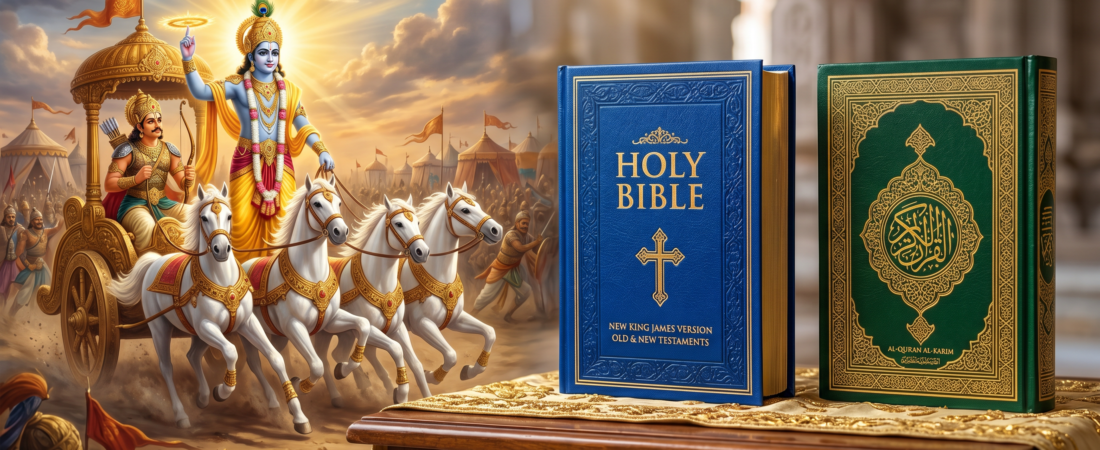
The Bhagavad Gita, often simply called “the Gita,” is one of the most celebrated philosophical and spiritual texts ever composed. It forms a small but luminous part of the vast Indian epic, the Mahabharata, and consists of 700 verses of poetry arranged as a dialogue between the warrior-prince Arjuna and his divine charioteer, Lord Krishna. The setting — a battlefield on the eve of a great war — is no accident. The Gita uses the drama of conflict and moral crisis to explore the deepest questions of human existence: Who are we? How should we act? What truly matters?
Arjuna, seeing his own kinsmen arrayed as enemies on the opposite side of the battlefield, is gripped by anguish and refuses to fight. It is in this moment of existential collapse that Lord Krishna delivers his timeless teachings — teachings that have resonated with thinkers from ancient India to modern Silicon Valley, from Mahatma Gandhi to Albert Einstein and Oppenheimer.
This single verse encapsulates what modern psychology calls “process orientation” — focusing on effort rather than outcome. It is a prescription for reducing anxiety and performing at the highest level without being paralyzed by fear of failure. The relevance of this teaching in today’s high-pressure world cannot be overstated.
The Gita explores multiple paths to spiritual realization — Karma Yoga (the path of righteous action), Jnana Yoga (the path of knowledge and wisdom), Bhakti Yoga (the path of devotion and love), and Raja Yoga (the path of disciplined meditation). These are not competing doctrines but complementary approaches, acknowledging that different human temperaments find different routes to truth. This pluralism makes the Gita uniquely adaptable to every reader’s needs.
One of its most powerful contributions to human thought is the concept of the eternal Atman — the self that lies beneath ego, identity, and social role. The Gita teaches that the true self is neither born nor dies, cannot be burned by fire nor drowned by water. This vision of an indestructible inner core has given courage to millions facing suffering, loss, and death. It is a philosophy of radical inner freedom.
-
Mental Resilience in Adversity
The Gita’s teachings on equanimity, detachment from results, and the mastery of the mind provide a practical toolkit for managing stress, depression, and existential crisis in the modern world.
-
Ethics of Duty (Dharma)
The concept of Dharma — performing one’s righteous duty without selfish motive — is a universal moral framework that transcends religion. It speaks to everyone who holds responsibility toward others.
-
Understanding the Nature of the Self
Krishna’s discourse on the immortal soul (Atman) and its relationship to the body, mind, and universe offers a philosophical framework that addresses questions modern science alone cannot answer.
-
Influence on World Thought
The Gita has shaped the thinking of Mahatma Gandhi, Aldous Huxley, Ralph Waldo Emerson, Henry David Thoreau, Robert Oppenheimer, and countless other intellectual and spiritual leaders across the globe.
-
A Universal Leadership Manual
Management schools in India and abroad use the Gita as a text on ethical leadership, decision-making under uncertainty, and servant leadership — its wisdom applies in boardrooms and battlefield alike.
-
Path Beyond Religion
The Gita does not demand conversion or ritual adherence. It invites every seeker — regardless of faith — to reflect, inquire, and discover. It is as much a work of philosophy as it is of religion.
Reading the Bhagavad Gita is reading a conversation between the human soul and the divine, set not in a distant paradise but on a dusty, urgent battlefield. Its message is that clarity, courage, and duty are always available to us — if we are willing to listen.
The Bible is not a single book. It is a library — a collection of 66 books written across more than a thousand years, by dozens of authors, in multiple languages and literary forms. Poetry and prophecy, history and law, letters and apocalypse, love songs and lamentations — all find their place within its pages. No single human work has shaped Western civilization more profoundly. Its narratives are woven into the language, law, art, music, and moral imagination of the modern world in ways so deep that most people never notice the seams.
The Old Testament opens with the creation of the universe and traces the long, tumultuous story of the Hebrew people — their covenant with God, their suffering and liberation, their kings and prophets, their failures and renewals. It is filled with some of history’s most enduring stories: the Garden of Eden, Noah’s Ark, the Exodus from Egypt, the wisdom of Solomon, the poetry of the Psalms, and the prophecies of Isaiah. These are not merely religious texts — they are foundational myths of humanity in the deepest sense.
The New Testament shifts the narrative dramatically with the life, teachings, death, and resurrection of Jesus of Nazareth — a figure whose influence on human history is arguably unparalleled. The four Gospels (Matthew, Mark, Luke, and John) present his life through different lenses, capturing his parables, miracles, and radical moral teachings. What Jesus taught challenged every hierarchy of his time: love your enemies, bless those who curse you, the meek shall inherit the earth. These are not comfortable ideas — they are revolutionary ones.
The letters of Paul, Peter, and John that follow the Gospels address the challenges of building communities of faith across diverse cultures in the Roman Empire — a challenge remarkably similar to the task of building inclusive societies today. The theological wrestling, ethical debates, and pastoral care found in these epistles speak directly to questions of community, justice, and identity that remain urgent in our time.
-
The Ethics of Love and Compassion
No text in human history has more consistently emphasized the ethical necessity of love — not merely as feeling but as action, especially toward the poor, the outcast, and the enemy.
-
Foundation of Western Law and Culture
The Ten Commandments and the Sermon on the Mount form the moral backbone of democratic societies, human rights frameworks, and legal systems across the Western world and beyond.
-
Unparalleled Cultural Influence
From Michelangelo’s Sistine Chapel to Bach’s cantatas, from Shakespeare’s plays to Toni Morrison’s novels — the Bible’s imagery, language, and stories permeate virtually all of Western artistic and literary culture.
-
Honest Portrayal of Human Suffering
The Psalms, Job, and Lamentations are among the most honest expressions of human anguish ever recorded. The Bible does not pretend faith makes life easy — it walks with the sufferer in their pain.
-
A Vision of Social Justice
The Hebrew prophets — Isaiah, Amos, Micah — thundered against injustice, corruption, and the exploitation of the poor with a passion that inspired Martin Luther King Jr., Desmond Tutu, and liberation theologians worldwide.
-
The Power of Forgiveness and Renewal
The recurring biblical theme of redemption — that no person is beyond recovery, that failures are not final — has offered hope and transformation to countless people across every culture and century.
The Bible’s enduring power lies not in any single doctrine but in its extraordinary depth of human experience. It holds grief and joy, doubt and faith, sin and grace with equal honesty. To read it is to sit with the full weight of what it means to be human — and to discover that one is never entirely alone in that weight.
The Quran is, for 1.8 billion Muslims, the literal word of God (Allah) as revealed to the Prophet Muhammad (Peace Be Upon Him) through the Angel Jibreel (Gabriel) over a period of approximately 23 years, beginning in 610 CE in the city of Mecca. It is the final and most complete revelation in a chain that includes the Torah and the Bible — a fact the Quran itself affirms, naming Abraham, Moses, and Jesus as honored prophets of the same divine tradition.
The Quran is organized into 114 chapters called Surahs, each of varying length, addressing theology, law, ethics, history, science, and the nature of God, humanity, and the universe. Its very first word of revelation — “Iqra” meaning “Read” or “Recite” — is a declaration that knowledge, inquiry, and literacy are sacred acts. This is not incidental. The Islamic Golden Age, which preserved and advanced mathematics, astronomy, medicine, and philosophy while Europe languished in the Dark Ages, was partly fired by this Quranic imperative to seek knowledge.
The Quran’s prose — even in translation — carries a distinctive rhythm and power. In Arabic, it is considered unsurpassable in its literary beauty, and generations of poets, scholars, and calligraphers have devoted their lives to its interpretation and artistic expression. But its beauty is not merely aesthetic. Every verse (Ayat — a word that also means “sign”) is considered a window into divine reality, an invitation to reflect on both the outer world and the inner self.
The Quran addresses the great human questions with directness and depth. What is the purpose of life? How should wealth be used? What are our obligations to the poor? How do we treat prisoners, neighbors, and strangers? It outlines a system of ethics that balances individual rights with communal responsibility, spiritual aspiration with practical action. The concept of Zakat — mandatory charitable giving to the poor — is one of the Five Pillars of Islam and encodes social justice directly into the architecture of religious practice.
Importantly, the Quran addresses its message not only to Muslims but repeatedly to “humankind” (ya ayyuha al-nas). Its vision of human dignity is universal: every soul is created with inherent worth, and no person can bear the burden of another’s sin. This principle of individual moral responsibility was radical in its 7th-century context and remains foundational to modern concepts of justice.
-
A Sacred Invitation to Knowledge
The Quran’s very first command is to “Read.” It honors reason, observation, and scholarship as divine imperatives — a theology of knowledge that inspired centuries of Islamic scientific achievement.
-
A Comprehensive Framework for Justice
From economic fairness to the rights of women, orphans, and the poor, the Quran establishes detailed principles of social justice that remain remarkably progressive in many respects.
-
The Architecture of Mercy
Every Surah begins with “Bismillah ir-Rahman ir-Raheem” — In the name of God, the Most Compassionate, the Most Merciful. Mercy is not peripheral to the Quran’s message — it is its constant foundation.
-
Care for Creation
The Quran teaches that humanity is entrusted as a steward (khalifah) of the earth. This Quranic concept of environmental stewardship is inspiring a growing movement of Islamic environmentalism globally.
-
Understanding 1.8 Billion People
Muslims constitute nearly a quarter of the world’s population. Reading the Quran — with curiosity rather than fear — is one of the most powerful steps any non-Muslim can take toward genuine cross-cultural understanding.
-
Literary and Spiritual Masterpiece
In Arabic, the Quran is considered the pinnacle of linguistic beauty. Even in translation, its cadences and imagery are deeply moving. Reading it is a literary and spiritual experience unlike any other.
To read the Quran with an open mind is to encounter a text of extraordinary moral seriousness and spiritual intimacy. It speaks to God not as a distant force but as one closer to you than your jugular vein. For a world fractured by misunderstanding, few acts are more constructive than reading the text that forms the spiritual foundation of one in every four human beings on earth.
Three Books, One Humanity
The Bhagavad Gita was composed in ancient India. The Bible was written across the ancient Near East and Mediterranean world. The Quran was revealed in 7th-century Arabia. They emerged from different places, different ages, and different traditions — and yet, read side by side, they reveal a profound shared architecture of human aspiration.
All three affirm that there is something worth living for beyond pleasure and power. All three insist that how we treat the vulnerable reveals who we truly are. All three offer not a guarantee of comfort but a path of meaning — and this is perhaps the most honest thing any book can offer a human soul.
Reading these texts will not resolve every theological dispute or dissolve every religious difference. But it will make you a more empathetic, more thoughtful, more fully informed human being. And in an age of headlines that reduce the world’s great faiths to their worst moments, that matters more than ever.
The greatest conflicts of our time are not between religions — they are between ignorance and understanding. These three books are the antidote.
At Lens Point Network, we believe that the deepest journalism begins not with the story of today, but with the wisdom that has shaped all of human history. Read on. The world needs it.